TALK TO THE DADDY

Hello. Come on in. The daddy writes about current events, literature, music and, once in a while, drops something on you from back in the day to make you pause and ponder, stop and stare, and begin to wonder. Who knows? You may start to pace the floor, shake your head from side to side, then fall down on bended knees in a praying position and cry, "Lawd, have mercy! What is this world coming to?" Check yourself! But this blog is NOT about the daddy. It's about you: your boos, your fam, your hood, your country...our hopes and dreams of a better tomorrow. So let's make a pact: the daddy will put it on the track if you'll chase it down and hit him back. Together, we can definitely take it to another level. Shall we?"

Monday, April 6, 2009

Margaret Walker, a poet you should know

"She was a woman of ideas, a first-rate philosopher and thinker. She was one of the writers who celebrated black people much in the tradition of [ poets ] Gwendolyn Brooks and Sterling Brown."
--Sonia Sanchez, poet

"The poetry of a people comes from the deep recesses of the unconscious, the irrational and the collective body of our ancestral memories."

-- Margaret Walker, writer

Listen up. After receiving e-mails asking the daddy about poets, he decided to spend this week posting about well-known and lesser known poets that he believes all Americans, but especially African Americans, should know. Today, the daddy is feeling Margaret Walker, a great poet who wrote in the tradition of Gwendolyn Brooks and Sterling Brown.

Born in Birmingham, Ala., Margaret Abigail Walker was a poet, novelist (Her best known novel was “Jubilee”) and professor Emeritus at Jackson State College, in Jackson, Mississippi. She taught English and served as director of the Institute for the Study of History, Life and Culture of Black Peoples at Jackson State College.

She began writing in the 1930s and was still writing in the 1990’s, when she died at the age of 83. Her writing bridged the Harlem Renaissance of the 1920’s and 1930’s and the black arts movement of the 1960’s.

Another interesting fact about Ms. Walker is that she helped Richard Wright outline and do research for the book "Native Son."

"For My People,” her most famous poem, speaks of the struggles of blacks but also their yearning for a new day:

For My People

For my people everywhere singing their slave songs repeatedly: their
dirges and their ditties and their blues and jubilees, praying their
prayers nightly to an unknown god, bending their knees humbly
to an unseen power;

For my people lending their strength to the years, to the gone years
and the now years and the maybe years, washing ironing cooking
scrubbing sewing mending hoeing plowing digging planting
pruning patching dragging along never gaining never reaping
never knowing and never understanding;

For my people standing staring trying to fashion a better way from
confusion, from hypocrisy and misunderstanding, trying to
fashion a world that will hold all the people, all the faces, all the
adams and eves and their countless generations;

Let a new earth rise. Let another world be born. Let a bloody peace be
written in the sky. Let a second generation full of courage issue
forth; let a people loving freedom come to growth. Let a beauty
full of healing and a strength of final clenching be the pulsing in
our spirits and our blood. Let the martial songs be written, let
the dirges disappear. Let a race of men now rise and take control.

Sunday, April 5, 2009

Have some Wanda Coleman, a poet you should know

"you wear your loneliness like a trench coat pull its collar high against the chill as you walk the night whispers along the back alley of your soul."
--Wanda Coleman

Like Wallace Stegner, I am in the 'universal' tradition of writers who concern themselves with The Truth --never mind that it is apt to hurt someone, in some way,
most likely me.

--Wanda Coleman

Listen up. The daddy received e-mails asking him to re-post several poets he wrote about but they didn't know. So, for the rest of this week, the daddy will be posting about great but relatively not well known poets, beginning with Wanda Coleman.

Now, the daddy thinks that almost any poet will have a hard time getting a book published, marketed or sold. But this is especially true of black writers who unapologetically write honestly and assertively about the black condition, and even more so of those who write about poor blacks, the oppressed, the down-and-out: the brother who just lost his job, the hooker on the corner, the dealer down the street, the addict in an alley who by taking a needle and surging into the only God, the only savior he knows, is about to commit a petty crime, the status of black women in our society. Needless to say, this is not the kind of stuff that sells well at Barnes & Nobles.

Mari Evans, great poet and prime mover of the Black Arts Movement of the 1960’s, in an interview in Crisis, put it this way:

‘The only insurmountable obstacle I've faced is being a Black writer. Nobody has ever refused my work because I was a woman, but I've found that when we write about those things of which we are most passionate ... [they] are much more difficult to market. I haven't been able to crossover into that realm that would pay me more. What I write doesn't make me a bestselling author. I'm concerned about the issues that impact African American people. Even Black people want escape material, which is why street literature is so popular. They want to escape our issues, rather than standing and confronting them."

Like Evans, Wanda Coleman writes about the black condition, about black folks facing tough times, about tough black women facing tougher times still. Consider this bluesy reaction to the loss of a job:

"got a fifth o mad dog
to celebrate this day
got me a fifth o mad dog
to celebrate this day
a year of unemployment
and two weeks severance pay"

Yes, folks, when you’re poor, God can appear in the form of an unemployment check.

Or consider, in ‘Doing Battle with the Wolf at the Door," Coleman’s take on the police and the state.

“An occasional transfusion arrives in the mail
Or i find plasma in the streets
An occasional vampire flashes my way
But they don’t take much
My enemy is the wolf
Who eats even the mind

The wolf will come for me sooner or later
i know this
The wolf makes no sexual distinction
i am the right color
He has a fetish for black meat and
Frequently hunts with his mate alongside him"

But perhaps Coleman’s most memorable, most poignant truth about American society can be found in her poem ‘Women of My Color.” Here, Coleman
skillfully uses sex to draw the reader into the poem. And once she gets them there, drops drops knowledge like Einstein at the chalkboard or Sistah Souljah on the mike about what it means to be a black woman in patriarchal white America:

Women of my Color

by Wanda Coleman

i follow the curve of his penis
and go down

there is a peculiar light in which women
of my color are regarded by men

being on the bottom where pressures
are greatest is least desirable
would be better to be dead i
sometimes think

there is a peculiar light in which women
of my race are regarded by black men
as saints
as mothers
as sisters
as whores

but mostly as the enemy

it’s not our fault we are victims
who have chosen to struggle and stay alive

there is a peculiar light in which women
of my race are regarded by white men
as exotic 20
as enemy

but mostly as whores

it’s enough to make me cry
but i don’t

following the curve of his penis
i go down

will i ever see
the sun!

“Women of My Color" is classic Coleman; dropping truth, singing blues, and never forgetting-- to paraphrase James Brown, the godfather of soul-- to "make it funky'' in a country where folks would rather climb mountains, bungy jump, watch stupid soap operas or nod off to lame jokes by Jay Leno than hear what they know, deep in their hearts, is the real deal.

The daddy says drink from the cup of poetry. Go ahead: sip some hot soul from the truth-shaker, the sweet Momma Wanda, the Mad Dog Lady.

Go ahead. Have some Wanda Coleman. She's a poet you should know.
--------------------------------------------------
Books by Wanda Coleman:
1. Native in a Strange Land: Trials & Tremors (1996);
2. Hand Dance (1993);

3. African Sleeping Sickness (1990);

4. A War of Eyes & Other Stories (1988);
5. Heavy Daughter Blues: Poems & Stories 1968-1986 (1988);

6. Imagoes (1983); and

7. Mercurochrome: New Poems (2001).

8. Mambo Hips & Make Believe: A Novel, published by Black Sparrow Press.

Saturday, April 4, 2009

The Sound of Freedom: Marian Anderson, the Lincoln Memorial, and the Concert That Awakened America

An African-American, Anderson became an important figure in the struggle for black artists to overcome racial prejudice in the United States during the mid twentieth century. In 1939, the Daughters of the American Revolution (DAR) refused permission for Anderson to sing to an integrated audience in Constitution Hall. Their race-driven refusal placed Anderson into the spotlight of the international community on a level usually only found by high profile celebrities and politicians. With the aid of President Franklin D. Roosevelt and First Lady Eleanor Roosevelt, Anderson performed a critically acclaimed open-air concert on Easter Sunday, 1939 on the steps of the Lincoln Memorial in Washington, D.C. to a crowd of more than 75,000 people and a radio audience in the millions. She continued to break barriers for black artists in the United States, notably becoming the first black person, American or otherwise, to perform at the Metropolitan Opera in New York City on January 7, 1955."
--Wilkipedia

Listen up. The daddy was over at the fine blog "All About Jazz" and found a gem of a post. It's
about the book The Sound of Freedom, a biography of the classical singer Marian Anderson. Many of you already know about the incident at the Lincoln Center. But the book talks about the many years she spent overseas, honing her voice and performing. Political and cultural, the book, written by Raymond Arsenault, also spends a considerable time explaining how she moved those who heard her sing.

In the early 1930s, years before the concert at the Lincoln Memorial that made her an international symbol of the American civil rights movement, the great Philadelphia-born contralto was probably better known overseas than she was in the United States. Here's an excerpt from the book:

THE SOUND OF FREEDOM: Marian Anderson, the Lincoln Memorial, and the Concert That Awakened America
By Raymond Arsenault

Excerpt:

Andersons' concerts, which combined opera arias and German lieder with black spirituals, won over not just crowds and critics but also Europes classical music luminaries. After she performed at the Finnish composer Jean Sibeliuss country house in 1933, singing his compositions in his native language, he called out for not coffee, but champagne.

When Anderson (1897-1993) was smuggled in to sing at the 1935 Salzburg Festival after non-Aryans were banned by the Nazis, Arturo Toscanini was in the audience. Yours is a voice such as one hears once in a hundred years, he told her. His words stuck. For the rest of her life Anderson would be referred to as the voice of the century.

In his new book, The Sound of Freedom, Raymond Arsenault delivers not a proper biography of Anderson there have already been a couple of those, in addition to her 1956 autobiography but a tightly focused look at the political and cultural events that led up to and came after her famous 1939 concert. Its a story that is well worth retelling.

Anderson spent so much time in Europe partly because of the training and experience that touring there offered. She had also had her fill of segregated concert halls in America, and of its cultural climate in general. After a lifetime of being told that they were intellectually and culturally inferior, Mr. Arsenault writes, even many blacks questioned their races capacity to excel in the higher forms of art, theater, science, literature, sports, entertainment and music.

One of the few areas in which black artists were successful was popular music. Blacks were born to sing and shout, whites told themselves without any sense of irony or concern, Mr. Arsenault observes. Classical music was another matter. Mastery of classical technique required superior intelligence, discipline and years of training, he writes. Most white Americans had never encountered a major black composer, opera singer or virtuoso violinist. Indeed, one suspects that few whites could even imagine such a thing.

Andersons' emergence as a major performer in America in the mid-1930s was carefully orchestrated. She was sold to the news media, lest she be perceived as uppity, as both an international star and an unspoiled, unpretentious, working-class girl from South Philadelphia. She was Marian of Martin Street the same way Jennifer Lopez was later Jenny from the block.

Anderson did grow up poor. Her father, a railroad laborer, died when she was 12; she attend high school because her family depended on money she earned from singing and domestic work. (She later got a high school diploma.) Her voice was her ticket; there was a sense of destiny about her from the beginning. After she performed in a recital as a teenager, a music critic for The Chicago Defender wrote that tears of joy were in the eyes of many of the musicians who felt that a new era in music has risen for our people.

There are many, many weeping onlookers in this book. Anderson's voice and presence moved people. Calling one of her concerts the most dramatic experience I have had in 30 years of attending the theater, a Houston music critic described what Anderson looked like when she returned for an encore: And there, you thought, but for the Grace of God, stood somebody's negro cook.
-------------------------------------------------------------------------
Note: The following is Eleanor Roosevelt's resignation from the Daughter of the
American Revolution (DAR) for their refusal to allow Marian Anderson to sing
at Constitution Hall due to their policy of not allowing blacks on stage:

Eleanor Roosevelt's resignation

New York is reducing some of its harshest drug laws


Mexican soldiers heading to Juarez, Mexico to fight drug cartels vying to control the drug trade that sends drugs to the United States, where demand for marijuana is very high.

We are sending millions of dollars in additional equipment to provide more effective surveillance. We are providing hundreds of additional personnel that can help control the border, deal with customs issues. We are coordinating very effectively with the Mexican government and President Calderon, who has taken on a extraordinarily difficult task of dealing with these drug cartels that have gotten completely out of hand.
-- President Barack Obama, March 25, 2009

Listen up. Yesterday, the daddy talked about the failure of the U.S. phony war on drugs but how a few politicians are trying to change U.S. policy to cope with U.S. citizen's demand for drugs (especially cocaine), looking at decriminalization, emptying jail sells for criminals accused of small-time drug possession, and offering treatment over prison terms. The following piece looks specifically at how New York City, which has some of the most draconian drug laws, is changing. It's not perfect, but it's a good beginning. Check it out:

New York Lightens Up on Some of the Harshest Drug Laws in the Country By Steven Wishnia April 3, 3009

Let's hope the changes mark the beginning of the end of New York's Rockefeller drug laws.

Second, Rockefeller, the erstwhile standard-bearer of the Republicans' shrinking liberal wing, was contemplating another run for the party's presidential nomination, and he needed to prove that he was adequately "tough on crime."

The result was a law that mandated 15 years to life for sale of 2 ounces or more of heroin or cocaine or for possession of 4 ounces.

(Crime in New York continued to rise until the early 1990s, and New York City neighborhoods like Washington Heights and the Lower East Side -- low-income areas easily accessible to white buyers -- became open-air drug markets.)

Critics of the Rockefeller laws' harshness charge that they are "unjust and racially targeted," Linda Dechabert, head of Exponents, a harm-reduction group working with drug addicts, ex-prisoners and people with AIDS, said at the March 25 rally.

The racial disparities most likely stem from the ecology of the drug trade -- ghetto street dealers are more visible and violent than discreet white-collar dealers -- and the cumulative effects of racism in who gets stopped, who gets prosecuted and who gets imprisoned.

"It's easy to arrest blacks and Latinos, because they're in a confined area," notes Carl Dukes, 64, an ex-prisoner who attended the rally.

Another criticism is that penalties are determined by the weight of the drugs seized rather than by the defendant's role in the deal.

The most notorious case of that was Elaine Bartlett, a Harlem single mother who in 1983 was set up by an Albany cocaine dealer, who paid her $2,500 to deliver 4 ounces to him. Bartlett got 20 years to life, serving 16 years before she won clemency. Police allowed the dealer who hired her to continue operating in exchange for the information.

The state enacted mild reforms in 2004 and 2005. They reduced the 15-to-life sentences to 8 to 20 years, but did not affect the 90 percent of the state's drug prisoners convicted of lesser charges.

Activists developed four "pillars" for further-reaching reforms: restoring judicial discretion, expanding treatment and alternatives to prison, reducing sentences and retroactivity -- letting prisoners apply for the sentences they would have gotten under the revised laws.

By those standards, the proposed new law would do well on treatment. It's expected to provide an extra $50 million to $80 million for drug-treatment and alternatives-to-incarceration programs, such as the one run by the Brooklyn district attorney's office.

New York has a harm-reduction system well positioned to take advantage of this, notes Gabriel Sayegh of the Drug Policy Alliance, as there are well-established programs for drug rehab, needle exchange, methadone maintenance and overdose prevention.

Most activists agree, however, that the bill falls short on judicial discretion and retroactivity. For example, someone found guilty of selling drugs would still get an automatic 4 1/2-year minimum if they had been convicted of a violent felony in the past 10 years, says Gangi. Such a person might be dangerous -- or might have calmed down considerably since their previous crime.

"We're not saying people should not go to prison," he explains. "We're saying the judge should decide."

"It's unfair. You're caught with a little amount of drugs, and you serve a long, long term in prison," says Ashley O'Donoghue, a tall, thin man with "God's Son" tattooed on his neck. "It should be retroactive so the people who are still there can get a sentence that's more suitable for what they did."

O'Donoghue, 26, was arrested in 2003 when two white college students he'd been dealing cocaine to were nabbed and set him up for a 2 1/2-ounce sale, well above his usual range. Facing 15 to life, he pleaded guilty to a B felony and served five years of a 7-to-21-year sentence.

Comedian Randy Credico, a longtime drug-law activist who attended the March 25 rally dressed as Diogenes, "looking for an honest politician," says any changes in the law would be inadequate unless retroactive re-sentencing is "automatic." Less than half the 1,000 prisoners eligible to apply for shorter sentences under the 2004 law actually got them.

For the full story, click here:

Note: This article originally appeared in Alternet.

Friday, April 3, 2009

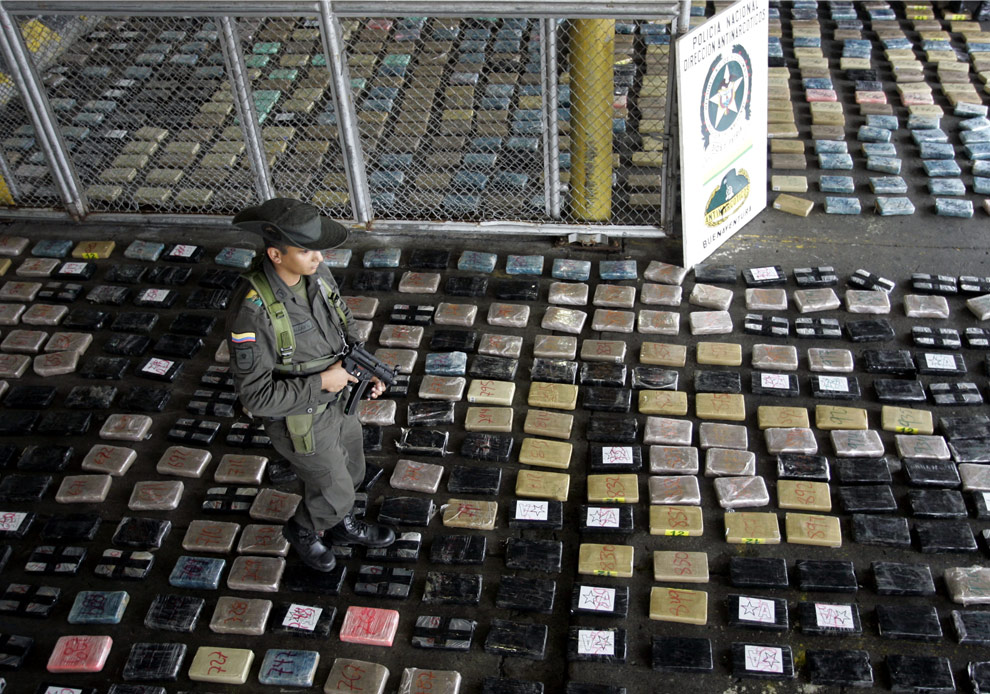
Finally, a little honesty about the so-called drug war


A police officer walks on packages of cocaine in Buenaventura, Colombia's main seaport on the Pacific coast, Monday, March 23, 2009. Colombian police had seized 3.5 tons of cocaine in a container of vegetable grease bound for Mexico. (AP Photo/Fernando Vergara)

-Nearly 6 in 10 persons in state prison for a drug offense have no history of violence or high-level drug selling activity;
--African Americans comprise 14% of regular drug users, but are 37% of those arrested for drug offenses and 56% of persons in state prison for drug offenses;
--African Americans serve almost as much time in federal prison for a drug offense (58.7 months) as whites do for a violent offense (61.7 months), largely due to racially disparate
sentencing laws such as the 100-to-1 crack-powder cocaine disparity."
--The Sentencing Project: "A 25-Year Quagmire: The War On Drugs And Its Impact on American Society."

Listen up. Today, the daddy is feeling an article by David Sirota, a well- known blogger and journalist. His post is about the phony U.S. "drug war." Now, the daddy has always believed that this so-called "war on drugs" was nothing more than a cover for arming and supporting right-wing governments and death squads in Latin America and an excuse to throw black males (and now hispanics) in jail rather than treat them. But Sirota thinks that some people in the U.S. government are waking up to the reality that this phony drug war is costly and is working against America's interest as a whole. It has not reduced demand and, more importantly, it is helping to fuel a real drug war among Mexican drug cartels below the border that is now spilling over into the United States. Check it out.
-----------------------------------------------------------------------------------------------------------------

Finally, a little honesty by David Sirota

Finally, after America has frittered away billions of taxpayers dollars arming Latin American death squads, airdropping toxic herbicide on equatorial farmland and incarcerating more of its own citizens on nonviolent drug charges than an y other industrialized nation, two political leaders last week tried to begin taming the most wildly out-of-control beast in the government zoo: federal narcotics policy.

It started with Secretary of State Hillary Clinton stating an embarrassingly obvious truth that politicians almost never discuss. In a speech about rising violence in Mexico, she said, “Our insatiable demand for illegal drugs fuels the drug trade,” and then added that “we have co-responsibility” for the cartel-driven carnage plaguing our southern border.

She’s right, of course. For all the Rambo-ish talk about waging a “war on drugs” that interdicts the supply of narcotics, we have not diminished demand—specifically, the demand for marijuana that cartels base their business on.

According to the Office of National Drug Control Policy, Americans spend about $9 billion a year on Mexican pot.

Add that to the roughly $36 billion worth of domestically produced weed, and cannabis has become one of the continent’s biggest cash crops. As any mob movie illustrates, mixing such “insatiable” demand for a product with statutes outlawing said product guarantees the emergence of a violent black market—in this case, one in which Mexican drug cartels reap 62 percent of their profits from U.S. marijuana sales.

That last stat, provided by the White House drug czar, is the silver lining. Every American concerned about Mexico’s security problems should be thankful that the cartels are so dependent on marijuana, and not a genuinely hazardous substance like heroin. Why? Because that means through pot legalization we can bring the marijuana trade out of the shadows and into the safety of the regulated economy, consequently eliminating the black market the cartels rely on. And here’s the best part: We can do so without fearing any more negative consequences than we already tolerate in our keg-party culture.

Though President Obama childishly laughed at a question about legalization during his recent town hall meeting, his government implicitly admits that marijuana is safer than light beer. Indeed, as federal agencies acknowledge alcohol’s key role in deadly illnesses and domestic violence, their latest anti-pot fear-mongering is an ad campaign insisting—I kid you not—that marijuana is dangerous because it makes people zone out on their couches and diminishes video gaming skills.

(This is your government on drugs: Cirrhosis and angry tank-topped lushes beating their wives are more acceptable risks than stoners sitting in their basements ineptly playing Halo ... any questions?).

Despite this idiocy, despite polls showing that most Americans support some form of legalization, and despite such legalization promising to generate billions of dollars in tax revenue, Clinton only acknowledged the uncomfortable reality about demand. That’s certainly no small step, but she did not address drug policy reform. Confronting that taboo subject was left to Sen. Jim Webb, D-Va.

Last week, this first-term lawmaker proposed creating a federal commission to examine potential changes to the prison system, including a relaxation of marijuana statutes.

Webb hails from a conservative-leaning swing state whose criminal justice laws are among the nation’s most draconian, so there’s about as much personal political upside for him in this fight as there is for Clinton—that is to say, almost none. That isn’t stopping him, though.

“The elephant in the bedroom in many discussions on the criminal justice system is the sharp increase in drug incarceration,” he said in a speech, later telling The Huffington Post that pot legalization “should be on the table.”

Finally, a little honesty—and now, maybe, some action.

David Sirota is the best-selling author of the books “Hostile Takeover” (2006) and “The Uprising” (2008). He is a fellow at the Campaign for America’s Future. Find his blog at OpenLeft.com or e-mail him at ds@davidsirota.com.

Thursday, April 2, 2009

What's Going? Marvin Gaye

"War is not the answer. Only true love will conquer hate."
--Marvin Gaye
"If you cannot fine peace within yourself, you will never find it anywhere else."

--Marvin Gaye

Listen up. Today, the daddy is feeling Marvin Gaye. Why? Because April 2 is his birthdate; and he's only one of the greatest R&B singers of all times.

And the daddy wants to ask you something: Do you remember him singing, "How sweet it is to be loved by you?" "I'll be doggone?" "Ain't that peculiar?" "Can I get a witness?" "Stubborn kin d of fellow?"
And do you remember him teaming up with a woman with Tami Terrell, a woman with a voice so sweet you could swear she was a bird-angel singing just outside your kitchen just for you? Do you remember those two voices melding together and singing, "Heaven must have sent you from above/Oh oh, heaven must have sent your precious love?" Yes, the Washing D.C. native, like the rest of black America, grew up listening to Ray Charles and being influenced by Nat King Cole and Frank Sinatra.

Yes, this talented young teen, like many others, grew up singing in a black church then singing with a group called The Moonglows before signing up with Tamla, a subsidiary of Motown. And, yes, the rest, as they say , was black history. Here are just a few nuggets to remember about Marving Gaye:


1. Marvin Gaye was more than a crooner or romantic singer. Yes, initially Marvin Gaye and Motown made hit after hit with him singing uptemp
o love songs . But Marvin was also a very good songwriter, a singer who penned socially relevant songs about love, family, the black community and violence. Want a good example, listen to the song he wrote called "Save the children" and how the bittersweet music matches the words. Even today-- or maybe, especially today, given the problems with youth in some black communities-- it will almost make you cry.

2. Marvin Gaye was not just a singer/ songwriter. He was also an advocate. When Barry Gordy resisted Marvin Gaye writing about the problems g
oing on in Detroit and other predominantly black communities as well as war, Marvin refused to record for Motown. After some time, and with intervention of people like Smokey Robinson, who had influence with Gordy, a compromise was reached: Marvin would record one more album, after which he would be able to record a socially relevant album. The result was the album "What's going on."

3. With "What's Going On, " Marvin recorded the first "concept" album ever , an entire album of songs tied to a specific theme or related ideas. The album included songs about war, violence, the ecology, and black unity: the need for the black community to talk to each other, find out "what's going on," and move as a community to improve their conditions. It was a great hit; and songs from that album are still being played today. The songs not only possessed good lyrics but a spirit or feeling that matched the feelings of blacks during the turbulent times of the Vietnam war abroad and black rebellions against oppression at home.

4 . Marvin's death was tied to family violence, an ongoing, serious problem in too many black families. As a child, Marvin often saw his father beat his mother and tried to intervene, only to get beaten himself. But when a grown up Marvin came back from Europe and was staying with his parents and saw his father attempt to beat his mother again, he said he would not allow it to happen this time. His father shot and killed him. There may be no greater story to illustrate the destructiveness of domestic violence in black families and the need for blacks to rid themselves of this scourge than the life and times of Marvin Gaye. On the other hand, the family violence, the drugs, the love of women (especially his love for Tami Terrell) and his problems recording the music about which he felt most passionately-- all seemed to fuel his passion as an artist and his stirring, legendary performances on stage.

Marvin Gaye is dead, but the resume of his work and the meaning of his life is there for us to hear and read. And on the road to quality music and positive humanity, he left thick footprints for us to follow.


Now, the daddy wants to ask you something:What's your favorite song of Marvin Gaye?

Wednesday, April 1, 2009

If Only The World Had Listened

"The certainty is that they are watching and it is on the decision of any one Israeli soldier or settler that my life depends."--Tom Hurndall

British peace activist Thomas Hurndall sits on the floor of a home in Rafah, minutes before he left to participate in a protest at which he suffered a gunshot wound to the head, in Rafah, southern Gaza Strip, Friday, April 11, 2003. Hurndall, age 22, from Manchester, England, had been standing between Israeli troops and Palestinian children when Israeli soldiers opened fire, according to a fellow activist from the International Solidarity Movement who witnessed the scene. He was declared brain dead after arrival at a Gaza hospital. (AP Photo/Khalil Hamra

Listen up. The daddy likes this dude named Robert Fist. He's a top-flight, award-winning foreign correspondent for The Independent and journalist in the same league with Bill Moyers, the great American journalist from PBS. If not, he's very close. Fisk has been covering wars in the Middle East for 30 years. His analyses of the governments there are proufound, his truth- telling about the people caught in the unending violence there sobering and heart- rendering.
One such story is that of Tom Hurndall, a 21 year old who died from a single shot in the head as he was rescuing a child from Israeli soldier gunfire. Now Tom's journals are being made into a book; and Tom's mother asked Frisk to write the preface. Here's what he wrote: Check it out.
If Only The World Had Listened
by Robert Frisk


I don’t know if I met Tom Hurndall. He was one of a bunch of “human shields” who turned up in Baghdad just before the Anglo-American invasion in 2003, the kind of folk we professional reporters make fun of. Tree huggers, that kind of thing. Now I wish I had met him because – looking back over the history of that terrible war – Hurndall’s journals (soon to be published) show a remarkable man of remarkable principle. “I may not be a human shield,” he wrote at 10.26 on 17 March from his Amman hotel.


In the wake of the death of her son, Jocelyn works to educate

Palestinian children on the West Bank.

"And may not adhere to the beliefs of those I have travelled with, but the way Britain and America plan to take Iraq is unnecessary and puts soldiers’ lives above those of civilians. For that I hope that Bush and Blair stand trial for war crimes.”

Hurndall got it about right, didn’t he? It wasn’t so simple as war/no war, black and white, he wrote. “Things I’ve heard and seen over the last few weeks proves what I already knew; neither the Iraqi regime, nor the American or British, are clean. Maybe Saddam needs to go but ... the air war that’s proposed is largely unnecessary and doesn’t discriminate between civilians and armed soldiers. Tens of thousands will die, maybe hundreds of thousands, just to save thousands of American soldiers having to fight honestly, hand to hand. It is wrong.” Oh, how many of my professional colleagues wrote like this on the eve of war? Not many.

We pooh-poohed the Hurndalls and their friends as groupies even when they did briefly enter the South Baghdad electricity station and met one engineer, Attiah Bakir, who had been horrifyingly wounded 11 years earlier when an American bomb blew a fragment of metal into his brain. “You can see now where it struck,” Hurndall wrote in an email from Baghdad, “caving in the central third of his forehead and removing the bone totally. Above the bridge of his broken nose, there is only a cavity with scarred skin covering the prominent gap…”

A picture of Attiah Bakir stares out of the book, a distinguished, brave man who refused to leave his place of work as the next war approached. He was silenced only when one of Hurndall’s friends made the mistake of asking what he thought of Saddam’s government. I cringed for the poor man. “Minders” were everywhere in those early days. Talking to any civilian was almost criminally foolish. Iraqis were forbidden from talking to foreigners. Hence all those bloody “minders” (many of whom, of course, ended up working for Baghdad journalists after Saddam’s overthrow).

Hurndall had a dispassionate eye. “Nowhere in the world have I ever seen so many stars as now in the western deserts of Iraq,” he wrote on 22 February. “How can somewhere so beautiful be so wrought with terror and war as it is soon to be?” In answer to the questions asked of them by the BBC, ITV, WBO, CNN, al-Jazeera and others, Hurndall had no single reply. “I don’t think there could be one, two or 100 responses,” he wrote. “To each of us our own, but not one of us wants to die.” Prophetic words for Tom to have written.

You can see him smiling selflessly in several snapshots. He went to cover the refugee complex at Al-Rowaishid and moved inexorably towards Gaza where he was confronted by the massive tragedy of the Palestinians. “I woke up at about eight in my bed in Jerusalem and lay in until 9.30,” he wrote. “We left at 10.00… Since then, I have been shot at, gassed, chased by soldiers, had sound grenades thrown within metres of me, been hit by falling debris…”

Hurndall was trying to save Palestinian homes and infrastructure but frequently came under Israeli fire and seemed to have lost his fear of death. “While approaching the area, they (the Israelis) continually fired one- to two-second bursts from what I could see was a Bradley fighting vehicle… It was strange that as we approached and the guns were firing, it sent shivers down my spine, but nothing more than that. We walked down the middle of the street, wearing bright orange, and one of us shouted through a loudspeaker, ‘We are International volunteers. Don’t shoot!’ That was followed by another volley of fire, though I can’t be sure where from…”

Tom Hurndall had stayed in Rafah. He was only 21 where – in his mother’s words – he lost his life through a single, selfless, human act. “Tom was shot in the head as he carried a single Palestinian child out of the range of an Israeli army sniper.” Mrs Hurndall asked me to write a preface to Tom’s book and this article is his preface, for a brave man who stood alone and showed more courage than most if us dreamed of. Forget tree huggers. Hurndall was one good man and true.

--------------------------------------------------------------------------------------------------------------------

Note 1: This article originally appeared in The Independent.

Note 2: Evidently, Tom wasn't the only civilian or journalist who was killed intentionally by Israeli gunfire. Wilkipedia states, "On April 10, 2006, a British inquest jury at St Pancras coroner's court in London found that Hurndall had been "intentionally killed". Hurndall's father told reporters that there had been a "general policy" to shoot civilians in the area without fear of reprisals,[2] as stated by the soldier who fired the shot, Taysir Hayb. Hayb had earlier told a military tribunal that the Israeli army "fires freely in Rafah."[9] The lawyer representing the family, Michael Mansfield QC, stated: "Make no mistake about it, the Israeli defence force have today been found culpable by this jury of murder." A week earlier, an inquest found that the British journalist James Miller had been killed by an Israeli soldier just three weeks after Mr Hurndall was shot, a mile away from Hurndall's position. The coroner Dr. Andrew Reid stated that he would write to the attorney general about how similar incidences could be prevented, including the possible prosecutions of Israeli commanders, and that the case raised issues of command within the IDF. He stated that "two British citizens engaged in lawful activities" had been killed by Israeli soldiers, and that "British citizens, journalists, photographers or others may be subject to the risk of fatal shots."[10]